Why Education Is Entering a Period of Change
Education systems are mostly designed for a world that was predictable in those days. Clear career paths, stable institutions, and shared cultural norms determined what was taught, as well as how progress would be demonstrated. Such prior conditions do not exist the same way now. The altered models of economic uncertainty, rapid technological development, and globalization all are causing a necessity for faster adaptations in education.
This is the time of change that cannot be encoded in a single stroke as it has emerged as a storm system with pressure from different sides that have hit learners, educators, and institutions all at once. These obvious workings suggest why it is being perceived that traditional models can possibly be ineffective and even possible leads for the future systems.
From Stable Knowledge to Constant Update
For much of modern history, education focused on transferring established bodies of knowledge. Skills and information learned in early adulthood often remained relevant for decades. Today, knowledge changes more quickly. New tools, methods, and frameworks regularly replace older ones, especially in technical and professional fields.
This shift reduces the value of one-time education completed early in life. Instead, the ability to update skills becomes as important as the skills themselves. Educational systems are increasingly expected to support continuous learning, helping people return, reskill, and adapt without restarting from zero each time knowledge evolves.
Changing Expectations of Work and Careers
The idea of a single lifelong career is becoming less common. Many people now move between roles, industries, or forms of employment. This fluidity changes what education needs to provide. Credentials tied narrowly to one profession may be less useful than transferable skills that apply across contexts.
As work becomes more varied, education must prepare learners for uncertainty rather than specific job titles. This includes helping individuals navigate transitions, assess their own capabilities, and learn independently when formal guidance is unavailable.
Technology as Infrastructure, Not Disruption
Technology is often described as disrupting education, but its deeper role is infrastructural. Digital tools shape how information is accessed, shared, and evaluated. They influence attention, collaboration, and the pace of learning, even when classrooms remain physical.
Future education systems are likely to treat technology less as an add-on and more as an underlying condition. This requires careful choices about which tools support learning and which introduce distraction or inequality, rather than assuming all innovation is automatically beneficial.
Shifting Social Expectations of Education
Education is no longer seen only as preparation for employment. It is also expected to support civic understanding, personal development, and social cohesion. At the same time, rising costs and unequal outcomes have increased scrutiny of educational institutions.
These competing expectations create tension. Education must balance economic relevance with broader social purposes, while remaining accessible and credible. How systems manage this balance will strongly influence their future form.
Emerging Learning Models
New learning models are being explored as traditional structures are seen as inadequate to meet the educational needs of modern time. These approaches try to interface with rather than entirely replacing existing learning institutes in the field, which they supplement or even compete with each other to provide an informal context of knowledge dissemination. Together, they outline an educational topography defined by less restrictive tenure.
It is important to emphasise that there is no single model suitable for all learners when discussing specific approaches. The way of going into a future of education seems to be multiple solutions, not a solid, singular answer.
Blended and Hybrid Learning Environments
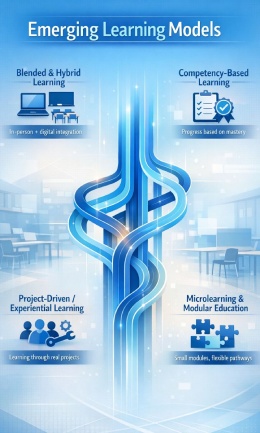
Blended learning combines in-person instruction with digital components. Rather than treating online and offline learning as separate, it integrates them into a single experience. This approach allows learners to move between self-paced study and guided interaction.
Hybrid environments can increase accessibility by reducing geographic and scheduling constraints. At the same time, they require thoughtful design. Without structure and support, flexibility can lead to disengagement. Effective blended models emphasize clarity, feedback, and purposeful interaction rather than simply digitizing existing content.
Competency-Based and Mastery-Oriented Learning
Traditional education often measures progress by time spent in class. Competency-based models shift the focus to what learners can actually do. Progress is based on demonstrating understanding or skill, not on completing a fixed number of hours.
This approach recognizes that learners progress at different speeds. Some may master concepts quickly, while others need more time and practice. By separating learning from rigid schedules, competency-based systems aim to reduce both boredom and frustration, though they require reliable methods for assessing mastery.
Project-Driven and Experiential Learning
Experiential learning emphasizes applying knowledge in real or simulated contexts. Projects, case studies, and collaborative problem-solving replace or supplement lectures and exams. Learning becomes something learners actively construct rather than passively receive.
This model aligns well with complex skills such as critical thinking and communication. However, it demands skilled facilitation and clear expectations. Without guidance, projects can become superficial. When well-designed, they help learners connect abstract ideas to practical challenges.
Microlearning and Modular Education
Microlearning breaks education into smaller, focused units that address specific skills or topics. These modules can be combined in different ways, allowing learners to build customized learning paths over time.
This approach fits well with adult learners balancing education with other responsibilities. It also challenges traditional credentials by emphasizing accumulation and relevance over formal degrees. The long-term impact of modular education depends on whether these units gain shared recognition and trust.
Evolving Skills for an Uncertain Future
Skills included in the definition of 21st-century skills include STEM skills and soft skills, such as critical and creative skills on which to survive in the highly dynamic new world. The emphasis has shifted from individually isolating subject-specific units to integrating all forms of education. Although these challenging abilities are straightforward to isolate, several critical forms of higher cognitive skills can interact with each other inside courses of learning and reinforce one another.
Learning How to Learn
The ability to learn independently is becoming a core skill. This includes setting goals, identifying resources, evaluating progress, and adjusting strategies when understanding breaks down. Learners who can manage their own learning are better equipped to adapt as knowledge changes.
Education systems can support this by making learning processes visible. Reflection, feedback, and metacognitive practices help learners understand not just what they are learning, but how they are learning it.
Critical Thinking and Judgment
Access to information is no longer the main challenge. The difficulty lies in evaluating sources, recognizing bias, and making informed judgments under uncertainty. Critical thinking involves questioning assumptions and weighing evidence, not simply recalling facts.
Future education must move beyond rote assessment to cultivate these abilities. This often requires open-ended tasks, discussion, and exposure to ambiguity, which can be uncomfortable but valuable for long-term development.
Communication Across Contexts
Communication skills extend beyond writing and speaking clearly. They include adapting messages to different audiences, working across cultural boundaries, and collaborating in diverse teams. As work and learning become more interconnected, these skills gain importance.
Education can foster communication by emphasizing dialogue, peer feedback, and collaborative projects. These experiences help learners navigate disagreement and build shared understanding.
Ethical Awareness and Responsibility
As technology and data play larger roles in society, ethical considerations become unavoidable. Decisions about privacy, fairness, and impact affect many fields, not just specialized professions.
Education has a role in developing ethical awareness by encouraging learners to consider consequences and responsibilities. This does not mean prescribing fixed answers, but creating space for reflection and debate around real-world dilemmas.
The Role of Teachers and Institutions
Discussions about the future of education sometimes focus heavily on tools and platforms. Yet teachers and institutions remain central. Their roles may change, but their importance does not disappear.
Understanding how these roles evolve helps clarify what innovation can and cannot replace.
From Content Delivery to Learning Facilitation
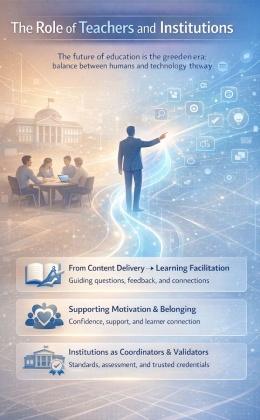
When information is widely available, the teacher’s role shifts from delivering content to guiding learning. This includes helping learners navigate resources, ask meaningful questions, and connect ideas.
Facilitation requires deep understanding of both subject matter and learning processes. It places greater emphasis on feedback, mentoring, and adaptation to individual needs, rather than uniform instruction.
Supporting Motivation and Belonging
Learning is not purely cognitive. Motivation, confidence, and a sense of belonging strongly influence outcomes. Teachers and institutions help create environments where learners feel supported and challenged.
As learning becomes more flexible and distributed, maintaining these social dimensions becomes more complex. Future systems must find ways to foster connection even when learners are not physically co-located.
Institutions as Coordinators and Validators
Educational institutions play an important role in setting standards and validating learning. As learning pathways diversify, this coordinating function may become more prominent.
Institutions may increasingly focus on assessment, credentialing, and quality assurance, working alongside a wider ecosystem of learning providers. Trust in these processes will be critical to maintaining coherence in a fragmented landscape.
Challenges and Risks Ahead
While the future of education holds promise, it also carries risks. Innovation does not automatically lead to improvement, and poorly designed changes can widen existing inequalities.
Acknowledging these challenges is necessary for responsible development.
Equity and Access
Digital learning can expand access, but it can also exclude those without reliable technology or supportive environments. Differences in resources, time, and prior preparation shape who benefits from new models.
Future education must address these disparities directly. Equity requires intentional design, not just availability of tools.
Quality and Overstandardization
As education scales through technology, there is a risk of oversimplifying learning to what is easiest to measure. Excessive standardization can reduce depth and discourage creativity.
Balancing scalability with meaningful learning remains a key challenge. Quality depends on context-sensitive judgment as much as on metrics.
Signals of What May Come
Rather than predicting a single outcome, it is more useful to look at signals that suggest possible directions. These signals indicate areas of experimentation that may influence future norms.
Education is increasingly seen as a lifelong process rather than a phase of early life. Systems are beginning to adapt by offering flexible entry points and ongoing support. This shift requires cultural change as much as structural change, redefining education as something people return to repeatedly.
Learning Forward, Not Replacing the Past
We cannot disconnect the future of learning from the present strategies we commonly practice. Many of the respected practices, in particular practices that support deep understanding, essential human connection, and shared standards, shall remain of importance. The change lies in the context in which these practices now function.
With the kind support: